
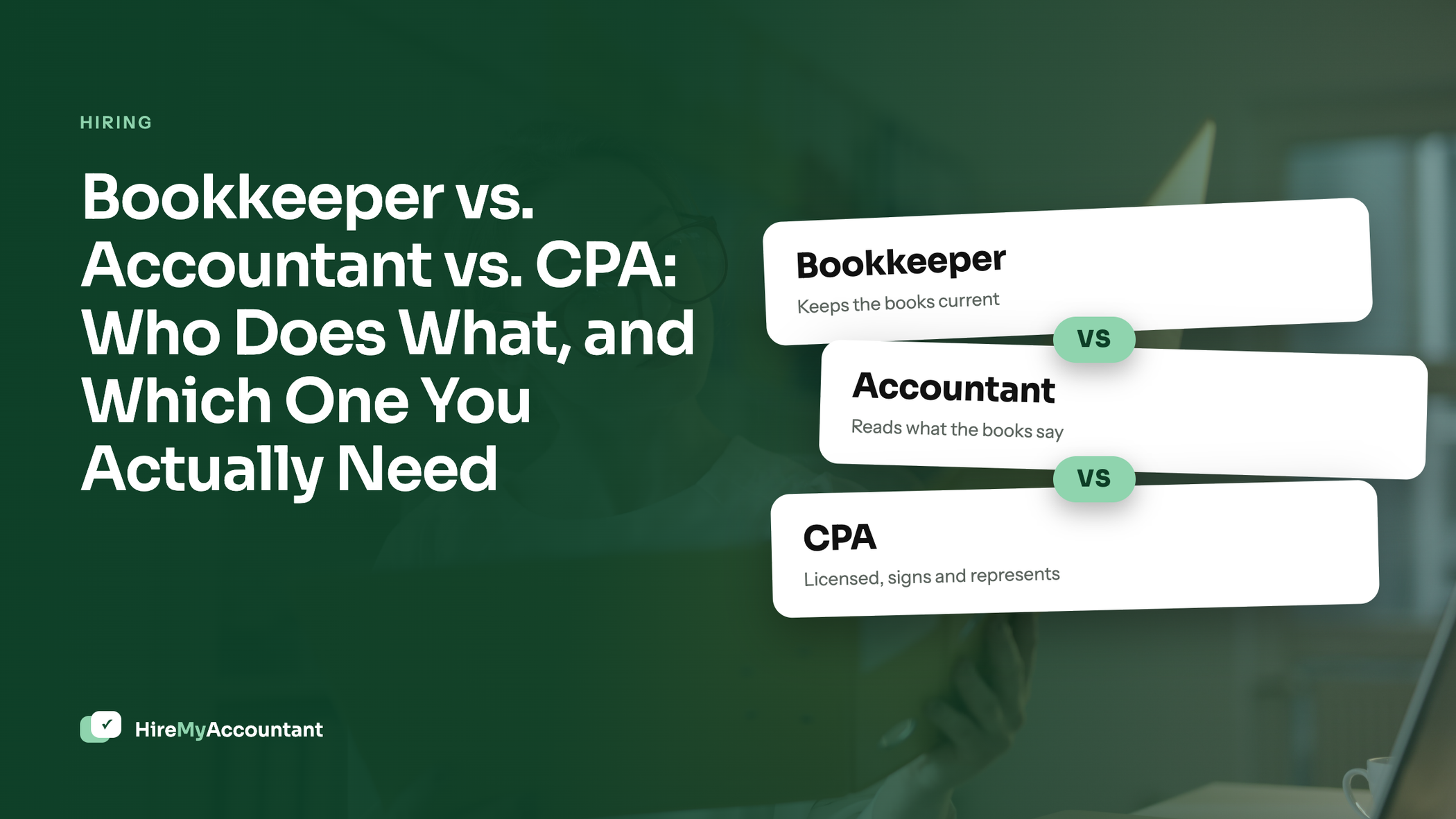
You've probably heard all three words used like they mean the same thing. They don't. A bookkeeper, an accountant and a CPA do three different jobs, and hiring the wrong one is how a small business ends up paying a lot for work it didn't need, or paying a little for work that wasn't enough.
By the end of this you'll know what each one does, which letters are real licenses and which are just job titles, and which person your business needs right now. Let's start with the one most owners meet first.
A Bookkeeper Keeps the Record of What Happened
A bookkeeper writes down every dollar that moves through your business. Money comes in from a customer, they record it. You buy a laptop, they record it and put it in the right category. At the end of the month they check that what's in your books matches what's in your bank account, which is called reconciling, and they hand you a simple report showing what you made and what you spent.
Think of it like keeping score during a game. The bookkeeper isn't deciding the plays. They're making sure the scoreboard is right, every single day, so nobody has to guess later.
Depending on the business, a bookkeeper might also send your invoices, chase the people who haven't paid, and run payroll. What they usually don't do is give you advice on taxes or strategy, and here's the part that surprises people: "bookkeeper" isn't a licensed title. There's no exam you have to pass to use the word. Plenty of bookkeepers hold certifications from software companies or trade groups, and those are worth asking about, but the title alone doesn't tell you anything.
A clean scoreboard only helps if somebody reads it and tells you what to do next. That's the accountant's job.
An Accountant Tells You What the Numbers Mean
An accountant takes the records your bookkeeper kept and turns them into decisions. They build your financial statements, prepare your tax return, and answer the questions a scoreboard can't: are we actually making money, can we afford to hire, should we be an S corporation, why is cash tight when sales are up.
If the bookkeeper keeps score, the accountant is the coach reading the scoreboard and calling the next play.
Now for the confusing bit. In most of the country, "accountant" isn't a protected title either. Most accountants have an accounting degree and real experience, but the word by itself isn't a license, so two people can both call themselves accountants and have very different training. That's why the next set of letters matters so much.
What Does CPA Actually Stand For, and Why Does It Matter?
CPA stands for Certified Public Accountant, and unlike the two titles above, it's a real license. A CPA has passed the Uniform CPA Examination, completed college coursework in accounting plus a period of supervised experience, and is licensed by their state board of accountancy. They also have to keep taking continuing education and follow an ethics code to keep the license, and the state board can take it away.
That license comes with a power the others don't have. The IRS gives CPAs unlimited representation rights, which means a CPA can stand in for you on any IRS matter: an audit, a payment problem, an appeal. You don't have to be in the room. If a bank or an investor ever asks for reviewed or audited financial statements, they'll expect a CPA firm's name on them too.
So a CPA is an accountant with a state license and the standing to deal with the IRS on your behalf. Every CPA is an accountant, but many accountants aren't CPAs. And there's a fourth title that trips people up, because it has the same IRS superpower without the CPA letters.
Where Do Enrolled Agents Fit In?
An Enrolled Agent, or EA, is a tax specialist licensed directly by the IRS. To earn it they pass a three-part Special Enrollment Examination covering tax planning, return preparation and representation, pass an IRS suitability check, and complete 72 hours of continuing education every three years.
EAs have the same unlimited representation rights as CPAs. They can handle your audit, your back taxes, your appeal. The difference is focus: a CPA's license covers all of accounting, while an EA's covers tax. An EA usually won't be building your financial statements or auditing anything, but if your problem is taxes, an EA is a complete answer, not a lesser one.
The thing to remember is that both groups can represent you before the IRS, which brings us to the group that can't.
Anyone With a PTIN Can Prepare Your Tax Return
The IRS puts it bluntly: anyone can be a paid tax return preparer as long as they have a Preparer Tax Identification Number, or PTIN. No exam, no degree, no license. That's the person at the pop-up storefront in February, and it's also some perfectly good preparers who just never went for a credential.
What a PTIN-only preparer can't do is represent you before the IRS. If a letter arrives, they can prepare the return, but they can't argue your case. Preparers who complete the IRS Annual Filing Season Program get a small step up: they can represent you, but only on returns they prepared and signed, and not for appeals or collection issues.
Two quick checks protect you here. First, the IRS keeps a public directory of preparers who hold a recognized credential or the filing season certificate, so if someone tells you they're a CPA or an EA, you can look them up. Second, the IRS warns about ghost preparers who won't put their name on the return they prepared. A real preparer signs the return and includes their PTIN, every time.
With the four titles sorted, the real question is which one your business should be calling.
Which One Do You Actually Need?
Match the person to the problem, not the other way around. It usually shakes out like this:
- You just started and money is tight. A bookkeeper, or accounting software plus a bookkeeper who checks in quarterly. You need clean records long before you need strategy. Firms that work with brand new businesses tend to package this.
- The business is running and you want numbers you understand every month. A bookkeeper doing monthly books, plus an accountant or CPA at year end for the return. Most bookkeeping-focused firms offer both under one roof.
- A letter from the IRS showed up, or you owe back taxes. A CPA or an EA, because they can stand in for you. Look for firms that handle IRS problems as a specialty rather than a side job.
- You're taking out a loan, bringing on investors, or selling. A CPA. Lenders and buyers want a licensed name on the financials.
- You've become an S corporation, hired employees, or sell in several states. A CPA or EA who already works with S corporations or businesses like yours. This is where the tax side gets complicated enough that experience with your setup matters more than the letters.
Most small businesses end up with two people: someone keeping the score every month, and someone licensed who handles taxes and the IRS. Often that's one firm doing both, which is fine as long as you know who's doing which part.
Whichever you land on, the same three checks apply before you sign anything.
Three Things to Check Before You Hire Any of Them
Ask what letters they hold, then verify them yourself. CPAs are listed by their state board of accountancy, and CPAs, EAs and filing season participants all appear in the IRS directory. It takes two minutes and it ends the conversation with anyone who's stretching the truth.
Ask who will actually do your work. At a lot of firms, the person you meet is the person who sells, and the person who does your books or your return is someone you'll never talk to. That can be fine. You just want to know it going in.
Ask how they'll communicate in March and April. Everyone is responsive in September. The answer that matters is how fast they get back to you when they have four hundred other returns on the desk.
If you'd rather skip the guessing, every firm on HireMyAccountant is listed by what they do and who they do it for, and the ones marked Vetted have sat through the same recorded interview so you can hear how they answer these questions before you ever pick up the phone. Start by browsing firms that match your situation, and if you'd like a second opinion first, reach out through the ask box on the homepage and we'll point you to the right kind of firm.