Hiring an accountant for the first time feels like buying a car with no sticker price. You don't know what's normal. You don't know what's too much.
So we looked. We read the prices that seven accounting firms post on their own websites. We also looked at what accountants we work with tell their clients. Here is what real firms charge right now, in plain English.
The short answer
These are the usual ranges we found. Your price could be higher or lower.
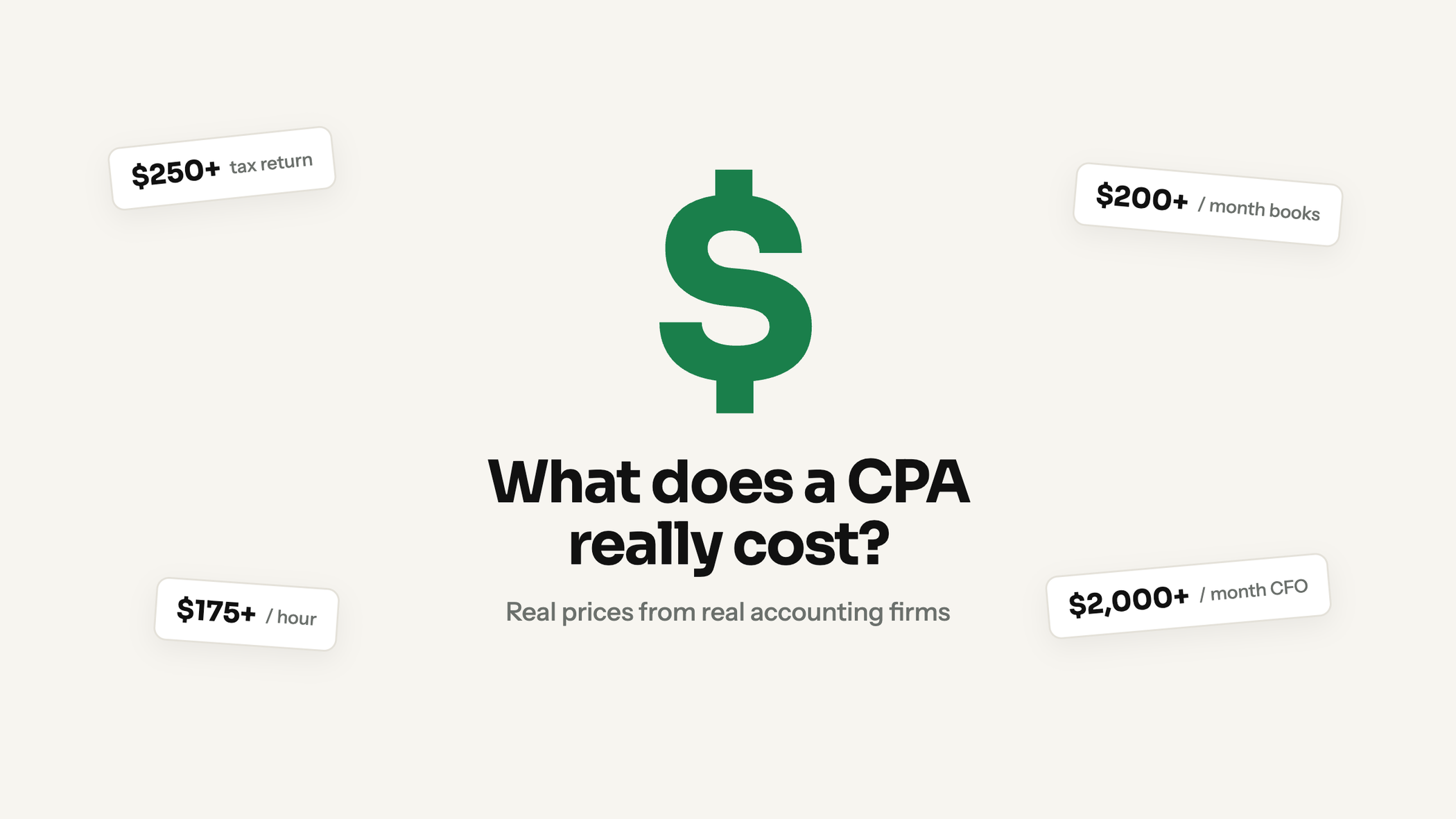
- Your personal tax return: about $250 to $900 a year.
- A tax return for your business: about $750 to $2,500 a year.
- Basic monthly bookkeeping: about $200 to $500 a month.
- Bookkeeping, taxes and advice in one package: about $1,000 to $2,500 a month.
- A part-time CFO (a money advisor for your business): about $2,000 to $5,000 a month.
- Work billed by the hour: about $175 to $425 an hour.
The rest of this guide explains each one. It also shows what makes a price go up or down.
First, a few words you'll see
Accountants use a lot of short names. Here is what they mean.
- CPA means Certified Public Accountant. A CPA passed a hard exam and holds a license from their state.
- EA means Enrolled Agent. An EA is a tax expert who passed an exam given by the IRS.
- Bookkeeping is keeping track of the money going in and out of your business, every month.
- Form 1040 is the main tax form for a person. Almost everyone files one.
- Schedule C is an extra page on your 1040. You add it if you earn money on your own, like freelancing or a side gig.
- A monthly package (some firms call it a retainer) is one set price each month for a bundle of help.
- Tax planning means making moves during the year to lower next year's taxes. Filing a return only looks back. Planning looks ahead.
What does it cost to do my personal taxes?
The firms we looked at charge about $250 to $900 for a personal tax return. Where you land depends on how much is on your return.
Here are some simple examples.
You have one job and a W-2. Your return is simple. Expect the low end of that range.
You have one job and a side gig. Say you drive for a delivery app on weekends. Now you need a Schedule C. That adds work, so expect to pay more.
You own a rental home. Each rental adds its own page. One accountant we work with adds about $250 for each rental property.
You also own a business. Some firms charge more for your personal return when they also do your business return. We saw personal returns priced up to about $1,250 at firms that serve high earners.
For a national check, one large survey of tax preparers found the average CPA charged $280 for a simple 1040 in 2025 (Accounting Today, reporting on the NATP 2025 Fee Study). That is for the most basic return. Most people who hire a CPA have a bit more going on.
What does a business tax return cost?
A tax return for a small business usually costs about $750 to $2,500 a year at the firms we looked at. A common price for a business doing around $500,000 in sales was about $2,000.
Some firms have a minimum. We saw minimums of about $1,500 to $2,000 per business return. So if you own three small companies, you may pay that minimum three times.
This is where a lot of people get surprised. They expect a few hundred dollars. Business returns take more work, so they cost more.
What does monthly bookkeeping cost?
Basic bookkeeping starts at about $200 to $500 a month. For that price, someone sorts every bank and card charge into the right bucket. They also match your records to your bank each month.
The biggest thing that sets the price is how many transactions you have. A transaction is any single charge or payment. One accountant we work with prices about 80 to 100 transactions a month at around $350.
A few things push the price up:
- Selling products. Tracking inventory takes more work. One firm's basic plan goes from about $200 to $350 a month without inventory to about $500 to $700 with it.
- Payroll and sales tax. Adding these can move you past $1,000 a month.
- Messy books. If your records are behind, the firm has to catch up first. That cleanup is billed on top.
Cheap bookkeeping can cost you later. One accountant told us that paying $300 a month for bad books doesn't save money. It just moves the cost to tax season, when fixing it is harder.
What do all-in monthly packages cost?
Many firms now sell one monthly package. It can include bookkeeping, your tax returns, tax planning and regular check-in calls. These packages usually cost about $1,000 to $2,500 a month. The top tiers we saw were around $3,000 a month.
That sounds like a lot next to one tax return. But look at what you get. You get help all year, not one meeting in April. For a growing business, that is often the better deal.
Some firms also charge a one-time fee at the start. For example, one firm we list charges about $5,000 up front to build your tax plan. Then the monthly fee begins. Always ask if there is a setup fee.
What does a part-time CFO cost?
A CFO is a chief financial officer. In a big company, the CFO runs the money side. A small business can rent one part-time. This is often called a fractional CFO.
A part-time CFO usually costs about $2,000 to $5,000 a month. For that, you get help with budgets, cash planning and big decisions, like hiring or buying equipment. Most small businesses don't need this on day one. It makes sense once you are growing fast.
What does hourly work cost?
Some jobs are billed by the hour. We saw rates from about $175 to $425 an hour.
- Cleanup of old books was on the low end, around $175 an hour.
- Advice and planning ran around $350 an hour.
- Help with an IRS audit was at the top, around $425 an hour.
Hourly billing is not the norm for a simple tax return. It shows up for one-off jobs, like fixing old records or answering an IRS letter.
Why would my price be higher or lower?
A few things move the price more than anything else.
- How much is on your return. Each side gig, rental or stock sale adds work.
- The kind of business you own. Business returns cost more than personal ones.
- How clean your books are. Neat records mean less work and a lower bill.
- Filing only vs planning ahead. Planning costs more, and it's where you save money.
- When you show up. Coming in on April 10 can cost more. Some firms stop taking new clients near the deadline.
Does a CPA cost more than an EA?
Usually, yes, but only a little for tax returns. The same national survey found EAs charged $228 on average for a simple 1040, next to $280 for CPAs (Accounting Today).
Both can speak for you if the IRS contacts you. The IRS gives CPAs, EAs and tax attorneys what it calls "unlimited representation rights" (IRS). That means they can help you with an audit, a bill or an appeal.
So which do you need? If you only need help with taxes, an EA is often a great fit. If you also want help with your business books, reports or a bank loan, a CPA is often the better pick.
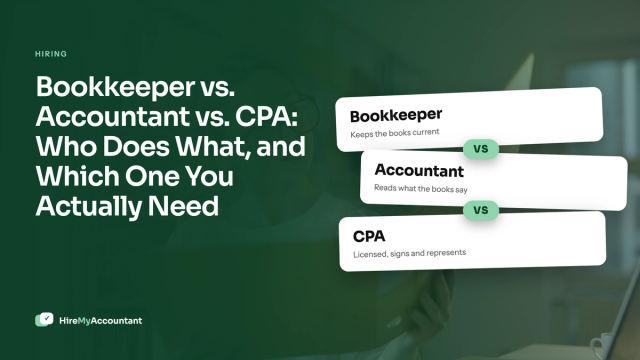
Other tax preparers can do your return, but they have fewer rights to speak for you with the IRS. Want the full picture? Read bookkeeper vs accountant vs CPA.
Is the cheapest accountant really cheaper?
Not always. A low price only saves money if the work is right.
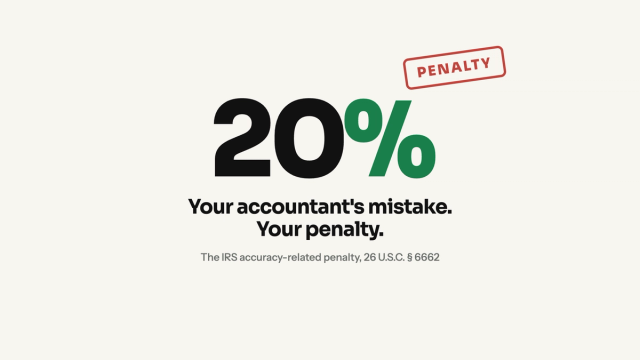
The IRS is clear about who pays for mistakes. It says "you're ultimately accountable for the accuracy of every item reported on your return," even though the preparer signs it (IRS Topic 254). So if your accountant makes an error, the bill comes to you.
We explain this more in the real cost of picking the wrong accountant.
Red flags when you compare prices
Walk away if you see any of these.
- They charge a percent of your refund. The IRS says to avoid preparers "who base their fees on a percentage of the refund" (IRS Topic 254).
- They won't sign your return. A paid preparer must sign it and put their PTIN on it by law (IRS Topic 254). A PTIN is an ID number the IRS gives every paid preparer.
- They give a price before asking anything. A real quote comes after they learn about your situation.
- They won't put it in writing. You should know what's included before any work starts.
How to get a price you can trust
You'll get a better quote, faster, if you come ready.
- Bring last year's tax return. It shows the accountant most of what they need to know.
- Write down what changed this year. Maybe you started a business, moved to a new state or sold a house.
- Be honest about your books. "They're a mess" is fine to say, and it helps them quote you right.
- Ask what's included and what costs extra.
- Ask if there is a setup fee.
- Ask who will do the work, and who you'll talk to.
- Get two or three quotes. Compare what each one includes, not just the price.
Finding the right fit
Price matters, but fit matters more. An accountant who already works with businesses like yours will be faster. Faster usually means cheaper.
Every firm on HireMyAccountant can be filtered by what it does and who it works with. For each vetted firm, a person reviewed what the firm publishes and what its clients say. Browse accountants by industry and city, or start with accountants for small businesses.